
Useful SEO Site - Wersja do druku
+- Akwarystyka - Forum akwarystyczne AkwaŚwiat (http://www.akwaswiat.net)
+-- Forum: Akwarium (http://www.akwaswiat.net/forumdisplay.php?fid=3)
+--- Forum: Szybkie pytanie, Szybka odpowiedź (http://www.akwaswiat.net/forumdisplay.php?fid=61)
+--- Temat: Useful SEO Site (/showthread.php?tid=40878)
+- Akwarystyka - Forum akwarystyczne AkwaŚwiat (http://www.akwaswiat.net)
+-- Forum: Akwarium (http://www.akwaswiat.net/forumdisplay.php?fid=3)
+--- Forum: Szybkie pytanie, Szybka odpowiedź (http://www.akwaswiat.net/forumdisplay.php?fid=61)
+--- Temat: Useful SEO Site (/showthread.php?tid=40878)
Useful SEO Site - FrankJScott - 12.04.2022
Seo Is A Better Option For Your Site
You're surrounded by information and constant updates from Google about your SEO. In 2022, these are some of the biggest ways to boost your website's traffic.
1. Utilize keywords that are relevant to your topic to create content
SEO tools such as Ahrefs, Surfer SEO, or Semrush will help you to determine the most relevant keywords for your content SEO strategy. The tools you use to plan your keywords will aid in aligning your content to what searchers want. Every piece of content that you produce should correspond to search intent as closely possible.
Make suggestions, regardless of what tool you choose to use.
Primary keywords. These keywords should be the primary subject.
Secondary keywords. They should be utilized in as many of the articles as is possible as well as on pillar pages.
Language support Keywords that are lower-level you can use throughout the text.
If you find important secondary keywords that are attracting sufficient search volume, conduct your own research to determine if it is possible to create articles and content specifically for them. When you publish articles about the larger subject and link them to an article about subtopics -and vice versa- you're telling search engines you have a good understanding of the keyword or subject, increasing the likelihood of being ranked for it. It is possible to stuff too much content into one page. This can lead to non-natural results for both your visitors and Google. You should also take into consideration the potential of long-tail phrases. They are typically less popular and contain more intent for transactions and are therefore ideal for content that can lead potential customers into the funnel. Check out best tools when launching ecommerce website for more.

2. Use effective titles and headings Although they may seem to be similar, headings and titles can be distinguished and placed in different areas of your site's code. The title should be included within the element of every HTML document you create, and also the It serves as a storage device for all the information on a web page's information. This includes information such as the title of the page, the language used and scripts to the analytics tool. The title (which is located between the and) Google and other spiders of search engines use tags (or keywords) to recognize pages' content at the top level. It will also be displayed in search engine results. It is important to use well-crafted titles.
Include the keyword you would like to get ranked for.
Click the links and then read the content.
SEO best practices require top-quality titles. A good title should be thought of prior to writing content. If your website pages are listed by search engines, and are ranked, but don't get clicks, Google will replace them in its search results with articles which do get clicked. Headings comprise the code that generates the page that your visitors will see. Insert the HTML title in the
tag. Subheadings for your subheadings must be placed between
and subheadings that are further with tags that vary from to.
Because they are looking to find the best sources of information, search engines are more likely to rank content that is of high quality. Google is able to rank your site with confidence because it is aware that this is the page that can answer all your questions. Check out best tools when launching ecommerce website for more.
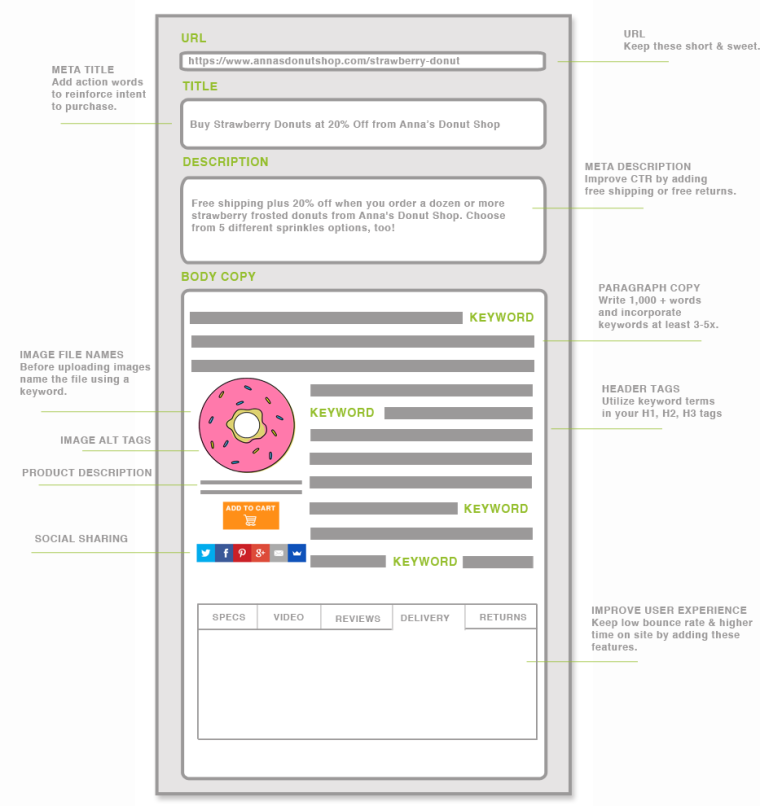
3. Write strong meta descriptions The meta description tag describes the block of text that appears alongside the content title on SERPs (search engine result pages). The meta description tag is just as the page title. It is also important to check the HTML code for each page. Consider the of the user experience. What kind of description could entice you to click on the link to learn more? Google often changes meta description. After analyzing user intent, they do their best to analyze your content and define it in terms of what they believe people are searching for, and then display it. Sometimes, they'll take text taken from meta descriptions or content of the page and modify it to increase its appeal. Meta descriptions are not used in the search rankings algorithm, but the click-through rate of your website from the results of a search is. Google may rewrite your meta description for you. It's worth it to search for the data you require. Look at how to improve ecommerce conversion rate for more.
4. Improve page speed The The code in the section of every HTML document is loaded before the visible part of a particular page does. This means that code in this section is not excessively complex. Since this area of a webpage is less accessible to other stakeholders, it can be neglected in the course of time. Many scripts to use Google Analytics and user behavior tools like Hotjar are often left out of the code. This causes a slowdown in the speed of download. If you're wondering how you can optimize your page speeds, you should benefit from Google's Lighthouse test. This tool will tell you what's affecting your loading speed. The tool gives information at a an extremely fine level. The information will tell that you "Hey this seven things are loading very slowly." Then, you can analyze this data to determine what is most important for your internal needs. Additionally, it is important to make sure that your CSS (cascading styling sheets) is clean. Keep them up-to-date and ensure that they are as efficient as possible. If you can compress CSS, do so. You don't need to take massive amounts of code. But every tenthof seconds is significant. Website managers with pages that are filled with information are likely to need Google and users to be as informed as possible. It's a good idea to ensure that your text is visible prior to the font loading. You can also benefit from lazy loading so that less content that is search-related such as images or video, are rendered after your site's text.